



NGS to Reduce Infectious Disease Diagnosis from 33 Days to 3 — Clinical Application Imminent
- 등록일 : 2025-07-01
기존에 한 달 이상 걸리던 감염병 진단을 단 3일 이내로 앞당길 수 있는 차세대염기서열분석(NGS) 기술이 임상 현장 적용을 눈앞에 두고 있다. 서울대병원 진단검사의학과 박재현 교수는 6월 27일, 삼정호텔에서 열린 대한임상미생물학회 춘계학술대회에서, “NGS 기반 감염 진단에서 가장 중요한 요소는 진단 속도(TAT)”라며, “기술은 이미 준비됐고, 속도와 실용성만 확보되면 병원 현장의 필수 도구로 자리 잡을 수 있다”고 밝혔다.
올해로 28회를 맞은 이번 학술대회는 ‘배양에서 전장유전체분석으로(From Culture to Whole Genome Sequencing)’라는 주제 아래, 감염 진단의 새로운 패러다임을 논의하는 자리였다. 박 교수는 기존 진단법의 한계를 지적하며, “배양은 느리고, PCR은 타겟이 제한적이며, 기존 시퀀싱 방식은 다중 감염이나 미지 병원체 탐지에 취약하다”고 강조했다.
서울대병원에서 실제 시행한 NGS 기반 감염 진단 검사는 시퀀싱 7일, 분석 및 보고 6일 등 전체 평균 33일이 소요됐다.
박 교수는 “1~3일 내에 결과가 나오지 않으면 임상에서는 무용지물”이라며, ‘속도 개선’이 기술 상용화의 핵심이라고 강조했다.
이어 그는 “기존 대형 시퀀싱 장비는 과적합이며, 임상 현장에는 오히려 MiSeq i100과 같은 작고 단순한 소형 NGS 플랫폼이 적합하다”고 말하며, 장비의 실용성 또한 병원 도입의 중요한 조건임을 언급했다.
박 교수는 발표에서 NGS의 임상적 필요성이 명확한 실제 사례로
▲다제내성균(MDRO) 확산 경로 추적
▲비결핵항산균(NTM) 감별 진단
▲CMV 등 바이러스 내성 변이 분석을 소개했다.
특히, NTM의 경우 기존 방법으로는 종(species) 구별이 어려워 오진 가능성이 높았지만, NGS는 정확한 종 수준 진단이 가능해 적절한 치료 시기를 놓치지 않게 도와준다는 설명이다.
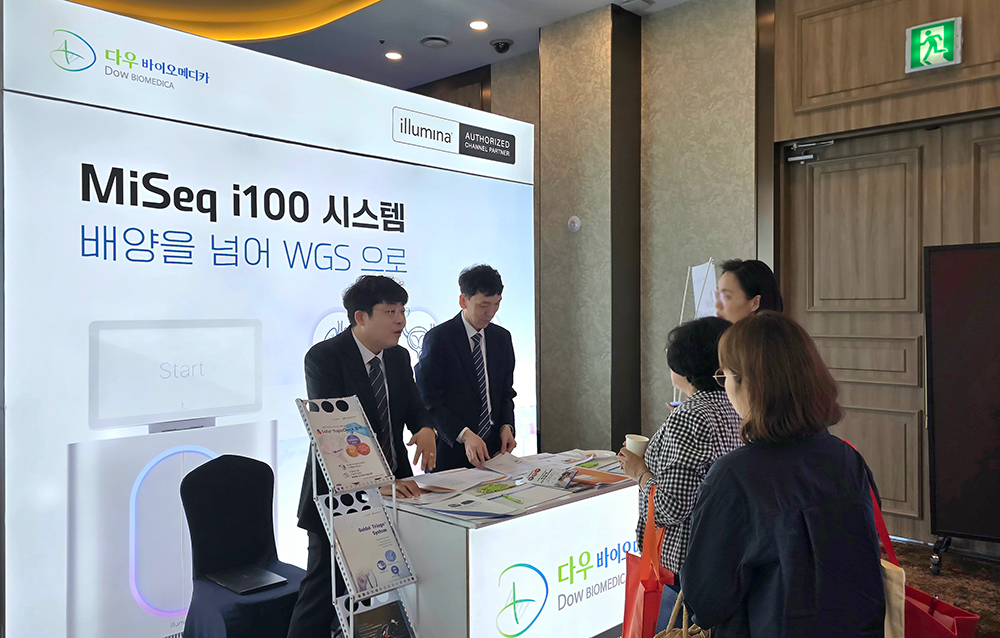
이날 학회 부스에서 Illumina의 공식 파트너인 ㈜다우바이오메디카는 소형 NGS 플랫폼인 MiSeq i100과 metagenomics 패널을 공개했다. MiSeq i100은 최신 시약 기술(XLEAP-SBS)이 적용돼 동급 장비 대비 4배 빠른 시퀀싱 속도를 제공하며, 내장된 DRAGEN 분석 플랫폼을 통해 분석부터 보고서 출력까지 장비 내에서 자동 처리된다.
(주)다우바이오메디카는 이 장비와 함께 호흡기(RPIP) 및 비뇨기(UPIP) 감염에 특화된 metagenomics 패널도 선보였다. 배양 절차 없이 객담이나 소변 검체에서 세균·진균·바이러스 동정과 항생제 내성 유전자 분석이 가능해, 중환자 맞춤형 치료와 항생제 스튜어드십 강화를 동시에 기대할 수 있다.
현재 해당 제품은 연구용(RUO)에 해당되지만, 다우바이오메디카는 임상 수요 증가에 맞춰 LDT 기반 신의료기술평가를 준비 중이다. 다우바이오메디카 관계자는 “정밀 메타지노믹스 기술은 감염병 진단의 미래를 바꿀 열쇠”라며, “기술과 제도, 임상 수요가 동시에 무르익은 지금이야말로 현장 적용을 위한 골든타임”이라고 강조했다. 그는 이어 “환자 생명을 살릴 수 있는 기술이 신속히 사용될 수 있도록 학계와 정부의 전향적인 규제 개선이 필요하다”고 밝혔다.
Next-generation sequencing (NGS), a technology that could dramatically reduce infectious disease diagnostic time from over a month to under three days, is now on the brink of clinical implementation in Korea.
At the 28th Spring Conference of the Korean Society of Clinical Microbiology held on June 27, Professor Jaehyun Park of Seoul National University Hospital emphasized that “Turnaround time (TAT) is the most critical factor in NGS-based infectious disease diagnostics.” He stated that while the technology is ready, improvements in speed and practicality are essential for NGS to become a standard tool in clinical settings.
Professor Park highlighted the limitations of traditional methods, noting that cultures are slow, PCR targets are limited, and conventional sequencing techniques struggle to detect co-infections or unknown pathogens.
In Seoul National University Hospital’s own study, NGS-based infectious disease testing currently takes an average of 33 days (7 for sequencing and 6 for analysis/reporting), which is impractical for real-time clinical decision-making.
“If results don’t come within 1–3 days, the test is clinically meaningless,” Park emphasized. He also noted that compact and streamlined NGS platforms, such as MiSeq i100, may be more appropriate for hospitals than large, complex sequencers.
He also shared clinical cases where NGS proved highly effective, such as:
-
Tracking the spread of multi-drug resistant organisms (MDROs)
- Differentiating non-tuberculous mycobacteria (NTM)
-
Analyzing viral resistance mutations, including CMV
For example, while traditional methods often fail to distinguish NTM species—leading to misdiagnosis—NGS enables species-level identification, supporting timely and appropriate treatment.
At the event, Dow Biomedica, the official partner of Illumina in Korea, showcased the MiSeq i100 along with targeted metagenomics panels for respiratory (RPIP) and urinary (UPIP) infections.
The MiSeq i100 features XLEAP-SBS chemistry that enables sequencing speeds four times faster than comparable systems. With its built-in DRAGEN analysis platform, the system offers end-to-end automation—from sequencing to report generation—within the device.
The metagenomics panels allow direct detection of bacteria, fungi, viruses, and antimicrobial resistance genes from samples like sputum and urine—without the need for culture—enabling personalized treatment for critical care patients and improving antimicrobial stewardship.
Though currently classified as Research Use Only (RUO), Dow Biomedica is preparing for clinical adoption through an LDT-based new medical technology evaluation, in line with growing demand in hospitals.
“Precision metagenomics holds the key to the future of infectious disease diagnostics,” a Dow Biomedica representative stated. “Now is the golden time to bring this technology into hospitals, with clinical demand, regulatory readiness, and technological maturity finally aligned.”
The company also called for regulatory reforms to ensure that life-saving technologies like NGS can be deployed without delay.